

Managing the Five Steps
As set out in the summary outline above, the Methodology is structured broadly into five steps. Some practical guidance on undertaking each of these steps is discussed in more detail below.
1.
Managing Desk Research
Desk research is necessary preparation to ensure that all available relevant information and background materials have been identified and analyzed. A thorough and fairly comprehensive understanding of the mandate of the IP office, its functions, management systems, and services is a goal of the IPOD process and careful desk research should provide much of this understanding.
Sources for desk research should include careful identification of relevant government web sites, beyond the web site of the IP office itself. This is likely to include the web site of any larger ministry of which the IP office is a part, central agency web sites which publish national strategic plans for the whole of government, as well as web sites of agencies responsible for particular areas of relevance to the IP system (such as agriculture, culture, industry, commerce, education and health, etc.) to find relevant information from sectoral strategic plans.
The desk research should be able to identify in relation to the particular IP office any strategic and operational plans, all relevant legislation, membership of international and regional agreements, organizational structure and staffing information, IP application and processing statistics, IP office budget information, etc. Not all of this information may be available on the web site of the IP office itself. IP legislation may be published on a whole of government legislation site or available on dedicated legislation sites such as WIPO’s Lex site (https://www.wipo.int/wipolex/en/index.html). The WIPO web site is also a good source for information about the relevant membership of the various IP treaties. Other relevant legislation relating to non-IP specific matters may need to be tracked down on the web site of the relevant government agency (such as legislation governing government employment, or legislation relating to government finances, or legislation relating to sector specific matters such as the labelling of goods or the marketing of agricultural products). Some global legal web sites can be helpful to identify possibly relevant legislation or provide access to relevant legislation in accessible languages (http://www.worldlii.org/ for example).
WIPO also provides significant online resources on many topics relating to the IP system which may be useful for the IPOD team to consult to assist with their analysis of a particular Topic. An edited sample of these resources is set out in Appendix 2(c).
Broader desk research looking for information about potential issues relating to the management and operations of the IP system in the country should be undertaken to identify any particular topics which may need to be followed up. Online searching using a few relevant search terms (such as “trademark dispute <name of country>”, “copyright infringement <name of relevant country>”, etc.) will usually find good background materials and may highlight some issues which should be followed up in the consultations. There are also useful information sources on the Internet such as a variety of academic or research papers on topics related to the IP or innovation system of the country.
Some of the desired information will not be readily available through desk research and will need to be identified and gathered through consultations and interviews.
2.
Managing Consultations
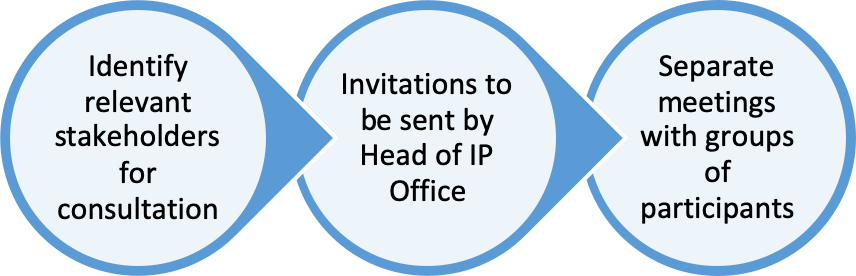
It will be necessary to organize consultations with relevant managers, staff and stakeholders for each of the Topics set out in Appendix 1. Each Topic outlines some particular information and guidance on how to undertake consultations relating specifically to the Topic, but some general guidance on organizing consultations is set out below.
When
planning and organizing consultation meetings, it would be best to have
separate meetings for the different groups and individuals as sensitive
information and feedback may be disclosed. These meetings will in most cases be
focussed on only one of the Topics, but in some cases (particularly with some
external stakeholders such as meeting with representatives of the IP
professions or with chambers of commerce) the discussions may cover a number of
the Topics.
For all
external stakeholder meetings, the invitations for consultation should be sent
by the head of the IP office explaining in broad terms the purpose of the
consultations and seeking their active contribution and feedback at these
discussions.
It will be important to prepare properly for
each consultation meeting to ensure that the meeting is efficiently conducted
and the people attending are prepared for the discussions. A useful way of
doing this is to prepare an outline agenda and the key questions for each
meeting and if possible, sending these in advance to those to be interviewed.
The agenda should be brief and focussed.
A model agenda should:
- Outline of the purpose of the IP office diagnostic and how the outcome of the interview/discussion will feed into the diagnostic report.
- Allow discussion of the interviewee’s role and experiences regarding the particular Topic(s) planned for the meeting.
- Gather any comments or suggestions as to how the interviewee’s experiences in relation to the Topic(s) could be improved.
- Indicate how the interviewee will be able to comment on any recommendations or proposals developed through the IPOD process.
Obviously, if it becomes clear that the agenda
needs to change as the meeting progresses the model should not be a constraint.
It is important to remember that consultations
do not have to be a physical face-to-face meeting although that would generally
be the preferred mode as it allows for greater depth in discussion and informal
interaction. Where it is not practical or feasible to meet physically the IPOD team
can rely on web conferencing tools such as Zoom, Skype, Webex
Meetings etc. to virtually meet with others.
Other means of obtaining feedback and
information could be via specially prepared questionnaire sent to selected stakeholders.
The use of questionnaires needs to be carefully managed. Only some stakeholders
will be in a position to respond appropriately to a request for information
through a questionnaire. Broadcast
questionnaires covering a wide range of Topics are unlikely to receive
appropriate attention or elicit useful responses. While students, IP
professionals, academia, and some institutions may be more amenable to
responding to questionnaires if the questions are clearly focussed on their
particular responsibilities and issues, members of the business community
generally are less likely to respond to a questionnaire.
The careful construction of the
questionnaires will be important, with a strong emphasis on ensuring that for
each recipient the questions are properly focussed and clear about what is
being requested. Questionnaires can also provide a framework for later discussion
with respondents. A discussion of issues relating to the development of
questionnaires and a sample of a survey questionnaire is set out in Appendix
2(b).
The external stakeholders to be consulted may
vary from country to country, but a general sample would probably include the
following (note the names of ministries will vary and in some cases the areas
identified below will be combined in a single ministry. It is the functions
that matter, not the names):
- Government ministries (almost any one
of which could be the IP office’s parent ministry).
- Ministry of Commerce
- Ministry of Trade
- Ministry of Economy
- Ministry of Finance
- Ministry of Science and Technology
- Ministry of Education
- Ministry of Culture
- Ministry of Justice
- Ministry of Foreign Affairs
- Ministry of Agriculture
- Ministry of Environment
- Ministry of Domestic Affairs (including police, customs and market regulation)
- External stakeholders.
- Business and industry associations
- Chambers of commerce
- Universities
- Research institutions and associations
- Organizations representing inventors and creators, including collective management organizations
- Consumer associations
- Associations of lawyers and attorneys (especially IP attorneys)
Guidance on possible specific questions to be
asked through consultations or through questionnaires is set out for each of
the ten Topics in Appendix 1.
3.
Preparing the Report
There is no fixed formula for the structure and content of the IPOD report. Nonetheless, there are certain elements that would be expected to be included in the report.
The report should identify the challenges faced by the particular IP office which the research and consultations have uncovered. These challenges may reflect government wide constraints and issues arising because of the economic circumstances of the country, as well as the particular circumstances of the IP office relating to issues such as backlogs or budget and staffing levels.
Much of the detailed content of the report should focus in particular on the issues affecting the efficiency and effectiveness of the operations of the IP office. The results of the analysis of each of the Topic areas examined should be reported and appropriate recommendations to address the issues identified should be made.
More holistically, the report should propose optimal business models and management practices that should be strategically adopted by the IP office to guide the overall implementation of the recommendations of the report.
The draft report should set out specific recommendations based on the information and data collected through the research phase and tailored to the specific IP office. All the recommendations should be well supported by setting out the results of the research and consultations that have been undertaken that lead to the recommendations. This can usually best be done by developing a report structure that reflects the key areas that are being prioritized for attention.
The recommendations themselves should be clear (not vague and generalised), and practical (pragmatic and implementable) -with some indication of the proposed timeframe for implementation. This is important to allow proper planning to implement the recommendations of the IPOD report to proceed.
Identifying possible recommendations should have occurred during the research and consultation processes. While the quantity of information collected during the research and consultations will invariably be considerable and not all of it may need to be reflected in recommendations, it is nonetheless highly likely that certain areas for improvement will have stood out to the IPOD team. These may just reflect and confirm the initial thoughts of the senior management group, but it is also quite common for certain gaps and weaknesses to become more prominent as the process continues. This is often the case because the IPOD process has been looking across the whole organisation and is able to identify issues which are common to many areas. Often individual local managers are not in a position to see the wider picture and therefore the new or different approaches and solutions that may be possible. Even senior management, because of the way the office is structured, may not have the perspective across the office which the IPOD team should be able to document and analyze. This is one of the critical insights into where the most value for improvement effort may be harvested.
Aside from any insight into common issues across the organisation, the IPOD team will also have been exposed to the depth of gaps and weaknesses in individual areas which will help frame the development of any recommendations. This is clearly a judgement that the IPOD team, with the assistance of any external expertise involved, needs to make. The experience and expertise of the IPOD team and any external expert will be critical to help weigh up the value of all the proposed improvement opportunities and identify the optimal recommendations.
Finally, the report should set out a draft high-level implementation plan with suggested milestones and performance indicators.
4.
Managing Report
Validation
As discussed in relation to the role of senior management in the IPOD process, the draft report (or at least an outline of the proposed content of the report) should be presented and carefully discussed with the senior management group to ensure that the directions and recommendations are going to be supported. This is a critical validation step.
A further round of wider consultations to validate and finalize the draft report should also be planned and executed. The focus should be on ensuring that the findings are accurate and accepted, and that the recommendations and solutions are practical and pragmatic, and therefore offer a good way forward for the particular IP office.
Various approaches to validation can be used. The issue of confidentiality discussed earlier is again relevant here. As noted in the discussion concerning the role of senior management, there is a need to build trust in the IPOD process and from both a senior management point of view and from the point of view of many contributors to the consultations, there is a need for some level of confidentiality in relation to both the findings and the sources of some of the information. This need raises particular challenges for any validation of the draft report’s findings and recommendations. Nonetheless, it is advisable that as far as possible the draft report’s finding and recommendations are tested with various stakeholders.
One approach is to organize a presentation of the key findings and recommendations tailored to the proposed audience. The staff of the IP office have a strong interest on the findings and recommendations and proposed changes in the IP office will not be possible without engaging with and involving the cooperation of staff. Subject to the agreement of senior management, this presentation should cover the fullest reporting of the IPOD’s findings and recommendations, including implications of proposed reforms and changes for the staff concerned. In particular, the high-level implementation planning in the draft report needs to be shared with key staff. A separate presentation, perhaps more narrowly focussed with more limited disclosure of gaps and weaknesses should also be organised for external stakeholders who have been previously consulted in the IPOD process.
If a high level of confidentiality is an ongoing issue, more individual and private validation consultations may need to be organized.
5.
Planning for
Implementation
It is strongly recommended that an implementation plan be developed for the recommendations of the IPOD report. This usually can only be fully developed after the recommendations of the IPOD report have been accepted by the senior management of the office. Nonetheless, in the IPOD report itself the bare bones of an implementation plan should be spelled out – what is being recommended, who should be responsible for implementing each of the recommendations, what sort of timeframe is envisaged to implement each of the recommendations, and what sort of resources may be required to implement each of the recommendations.
Once the draft report and recommendations have been accepted by senior management, full implementation planning should be undertaken. This is a very important step to complete the IPOD process.
It is strongly recommended that implementation should be managed through a project team led by a senior manager. A suitable project management approach should be adopted to enable effective implementation with proper monitoring of progress and evaluation of the results achieved. Clearly defined responsibilities and accountabilities should be documented for the project team. There are various methodologies for developing implementation plans and managing implementation. Detailed project management guidance is not included in this Methodology. Nonetheless, the basic principles of an approach such as using results-based management (RBM) frameworks as well as appropriate project management skills to prepare and manage implementation plans is highly recommended. Some further information about results-based management can be found in Appendix 2(d).